
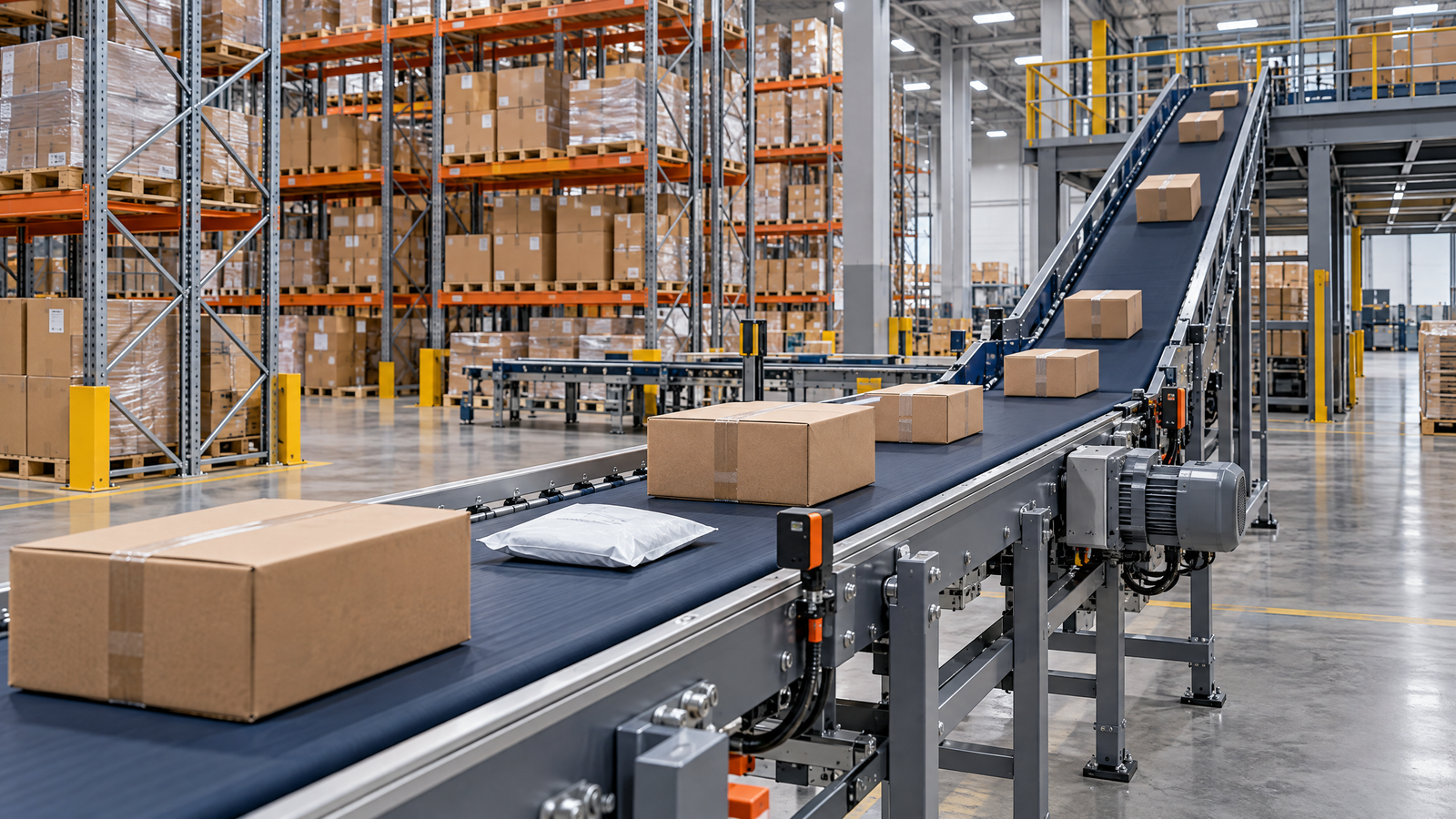
Choosing the right material handling backbone is one of the most critical decisions in warehouse design. Whether you are scaling an existing e-commerce fulfillment hub or setting up a high-speed packaging line, your conveyor system dictates your throughput speed, labor costs, and overall operational efficiency.
With so many configurations available, plant heads and B2B procurement leaders often ask: How to choose a belt conveyor for warehouse operations?
In this comprehensive guide, we explore the essential factors, belt types, and engineering considerations to help you select the ideal belt conveyor system for your facility.
Analyze Your Product Characteristics and Material Flow
Before diving into structural designs, evaluate the exact nature of the items moving through your warehouse:
- Size and Shape: Uniform boxes and cartons move easily, while polybags, envelopes, small items, or irregularly shaped products require a continuous flat belt surface to prevent jamming or slipping between gaps.
- Weight and Load Capacity: Light-duty assembly and packaging lines require standard flat belts, whereas heavy unit loads or bulk material transport demand heavy-duty troughed or reinforced rubber belt systems.
- Environmental Conditions: Food processing and pharmaceutical plants require hygienic, corrosion-resistant stainless steel (SS 304) structures with food-grade PU belts, whereas harsh industrial environments require robust mild steel (MS) frames.
Select the Right Belt Conveyor Type for the Job
Different warehouse zones require specialized belt configurations to maximize space and efficiency:
- Flat Belt Conveyors: Designed for smooth, continuous horizontal transport of unit loads, boxed goods, sorting, and packaging lines.
- Inclined & Z-Type Belt Conveyors: Essential when routing products between different mezzanine levels, multi-floor warehouse layouts, or height elevations. Equipped with anti-rollback features, rough-top grip belts, or cleats, they prevent material slippage during vertical transit.
- Troughed Belt Conveyors: Built with 20° to 45° troughing idlers forming a “U” profile for continuous bulk material handling (such as grains, sand, or aggregates) without spillage.
- Telescopic & Truck Loading Belt Conveyors: Engineered for fast loading and unloading of trailers, containers, and delivery trucks by extending directly into vehicle bays.
- Wire Mesh Belt Conveyors: Heat-resistant and corrosion-proof open-weave SS belts ideal for specialized drying tunnels, high-temperature processing, or washdown zones.
Explore Our Complete Belt Conveyor Product Range
Evaluate Drive Mechanisms and Automation Integration
Modern warehouse automation relies on precise speed control and smart integration. When specifying your conveyor, consider:
- Speed Control: Opt for geared motor drives integrated with a Variable Frequency Drive (VFD) to allow adjustable speed matching for packaging, inspection, and sorting workflows.
- PLC Automation: Ensure your control panel is compatible with Programmable Logic Controllers (PLCs) and photoelectric sensors for automated routing, accumulation, and multi-zone synchronization.
Summary Selection Matrix
| Evaluation Criteria | Optimal Choice / Consideration |
| Primary Warehouse Task | Horizontal transport, packing, sorting, truck loading, or multi-level elevation |
| Product Type | Boxed goods, polybags, loose items, or bulk materials |
| Frame Material | Mild Steel (MS Powder Coated) for general warehousing; Stainless Steel (SS 304/316) for food/pharmaceutical environments |
| Drive & Control | Geared motor with VFD speed control and optional PLC sensor integration |
Conclusion
Choosing the right belt conveyor for your warehouse operations comes down to matching your product characteristics, structural constraints, and automation requirements with a ruggedly engineered system. By partnering with an experienced manufacturer that offers custom sizing, high-grade belt materials, and turnkey execution, you can eliminate bottlenecks and future-proof your material flow.
Ready to optimize your facility’s material handling? Explore custom-engineered solutions at Tech Trek Engineering.