
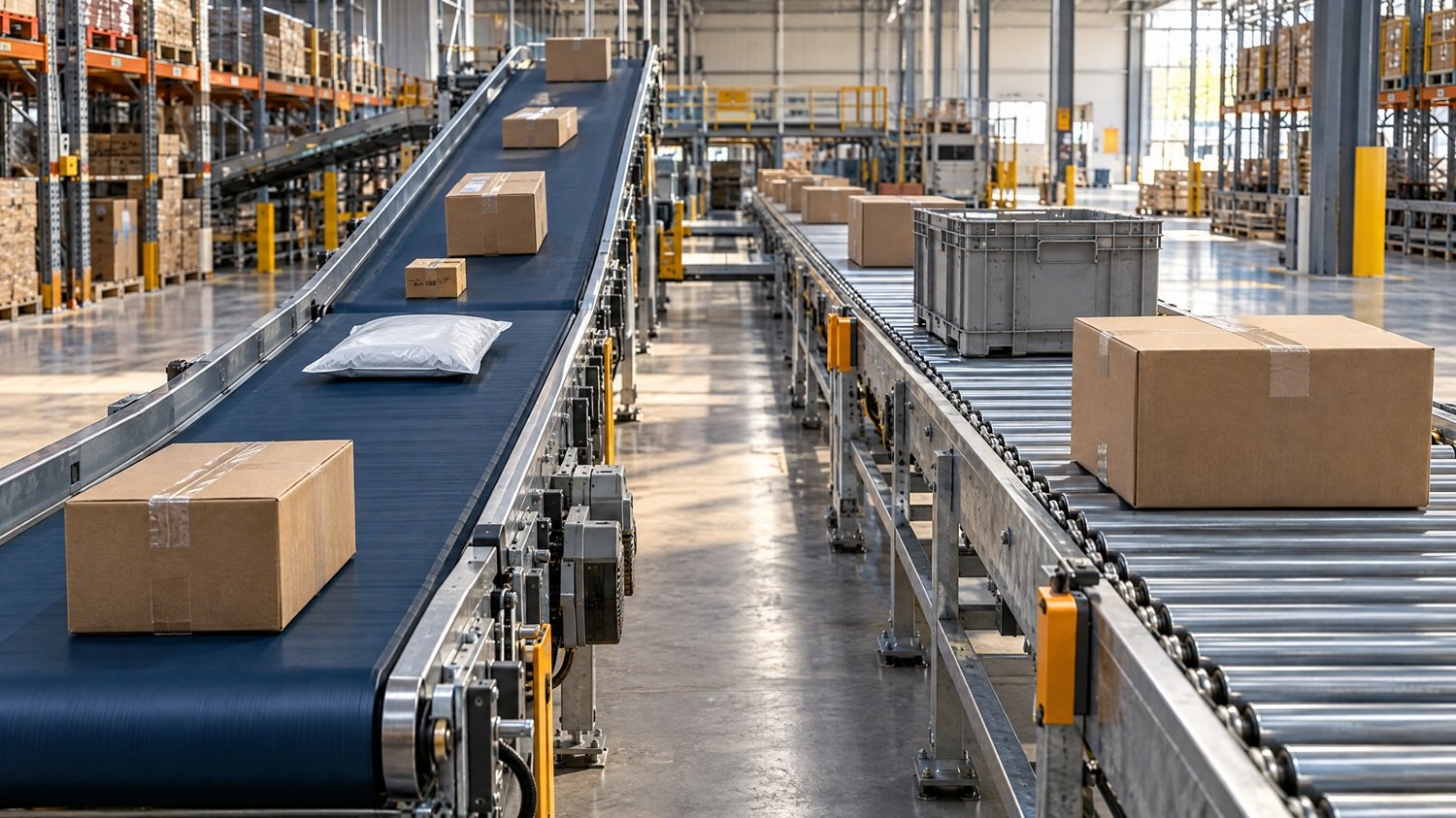
Choosing the right material handling backbone is one of the most critical decisions in warehouse design. Whether you are scaling an existing e-commerce fulfillment hub or setting up a heavy-duty assembly plant, your conveyor system dictates your throughput speed, labor costs, and overall operational efficiency.
Among the most common dilemmas facility managers face is choosing between two industry workhorses: Belt Conveyors and Roller Conveyors.
In this comprehensive guide, we compare their structural differences, load-bearing capacities, power consumption, and ideal industry environments to help you optimize your warehouse material flow.
1. Structural Differences: Continuous Surface vs. Rolling Support
The fundamental difference between belt and roller conveyors lies in how they support and move items.
Belt Conveyors: A belt conveyor utilizes a continuous loop of material (typically rubber, PVC, or fabric) stretched across two or more pulleys. Powered by a motor, the pulleys turn and move the belt smoothly across a solid slider bed or a series of support rollers. This provides a completely flat, continuous moving surface.
Roller Conveyors: Roller conveyors consist of a series of parallel metal or plastic tubes (rollers) mounted within a frame. Depending on the system design, these can be gravity-driven (sloped so items roll down naturally) or powered/live-roller (driven by internal motors, chains, or o-rings beneath the rollers). Instead of a continuous flat surface, items make contact only with the top tangent points of the rotating rollers.
2. Load-Bearing Capacities and Product Compatibility
Not all products travel well on every surface. Your inventory shape, weight, and packaging play a major role in system selection.
Belt Conveyors:
Best For: Small items, irregularly shaped packages, loose materials, bags, and products with uneven bottoms that might jam or slip between rollers.
Incline/Decline Capability: Exceptional. Because the belt provides continuous friction, belt conveyors can move products vertically or up/down inclines without slipping.
Load Capacity: Highly versatile. Standard systems handle moderate weights, while heavy-duty belt designs can manage substantial bulk and unit loads.
Roller Conveyors:
Best For: Flat-bottomed items like cardboard boxes, totes, pallets, and crates.
Incline/Decline Capability: Generally restricted to horizontal transport or gravity-fed drops (unless equipped with specialized high-friction slat attachments).
Load Capacity: Outstanding for heavy loads. Powered roller systems and heavy-duty pallet rollers easily support heavy automotive parts, metal sheets, and bulky industrial containers that would sag or tear a standard conveyor belt.
3. Power Usage and Energy Efficiency
Energy consumption is a major operational expense in large facilities. How power is utilized differs significantly between the two systems:
Belt Conveyors: Typically require a dedicated continuous motor drive to move the entire belt loop. Friction between the belt and the slider bed can increase energy draw, though low-friction slider beds and modern energy-efficient gear motors have greatly optimized power usage.
Roller Conveyors: Offer unique energy-saving configurations. Gravity roller conveyors require zero electrical power, relying entirely on gravity and operator push. Powered roller systems can utilize zone-controlled (zero-pressure) accumulation, meaning individual motor zones only activate when a package is actively passing over them. This drastically cuts down continuous power draw during periods of low throughput.
4. Ideal Industry Environments and Applications
Understanding where each system excels helps align your capital investment with practical plant requirements.
When to Choose Belt Conveyors:
E-Commerce & Parcel Fulfillment: Ideal for sorting mixed-size boxes, polybags, and envelopes moving at high speeds.
Food Processing & Pharmaceuticals: Continuous belt surfaces (especially sanitary PVC or stainless steel options) are easy to wash down, preventing crumbs or contaminants from falling into internal machinery.
Incline/Decline Transitions: Essential when routing products between different mezzanine levels or multi-floor warehouse layouts.
When to Choose Roller Conveyors:
Heavy Parts Manufacturing & Automotive: Perfect for moving heavy crates, engine blocks, stamped metal panels, and heavy-duty assembly pallets.
Case and Carton Handling Warehouses: Live-roller and accumulation roller systems allow boxes to accumulate (queue up) safely without crushing products or burning out motors.
Manual Packing & Assembly Lines: Gravity roller sections allow workers to effortlessly push, slide, or accumulate boxes manually without running continuous motor drives.
Summary Comparison Matrix
| Feature | Belt Conveyor | Roller Conveyor |
| Surface Type | Continuous flat belt | Series of parallel rotating tubes |
| Best For | Small, irregular, or bagged items | Flat-bottomed boxes, totes, pallets |
| Inclines / Declines | Excellent | Limited (unless gravity-fed decline) |
| Load Capacity | Versatile (light to heavy-duty options) | Exceptional for heavy, bulky unit loads |
| Energy Usage | Continuous motor drive | Can be gravity-driven or zero-pressure zoned |
| Primary Environments | E-commerce, food processing, packaging | Heavy manufacturing, warehousing, pallet handling |
Conclusion: Which One Should You Choose?
The right choice ultimately depends on your material flow goals. If your facility handles diverse product shapes, requires smooth vertical transitions, or demands sanitary continuous surfaces, a Belt Conveyor is your best bet. If your warehouse focuses on heavy uniform boxes, pallets, and efficient zero-pressure accumulation with lower energy footprints, a Roller Conveyor will serve you better.
Many state-of-the-art facilities actually use a hybrid approach—leveraging heavy-duty roller lines for main warehouse transport and pallet staging, while deploying belt conveyors for sorting lines and incline transitions.
People Also Asked (FAQs)
-
Can roller conveyors handle inclines?
Standard roller conveyors cannot push items uphill; they are typically used for horizontal transport or gravity-fed declines. Moving items upward requires a belt conveyor or specialized vertical lift/spiral conveyor.
-
Which conveyor system requires less maintenance?
Gravity roller conveyors generally require the least maintenance due to fewer moving parts and no motors. Powered roller and belt systems require periodic inspection of bearings, pulleys, rollers, and drive belts.
-
What is zero-pressure accumulation on a roller conveyor?
It is a design feature in powered roller conveyors where zones automatically stop when a box is present ahead of it, preventing products from colliding or applying pressure (“crushing force”) to the items preceding them.