
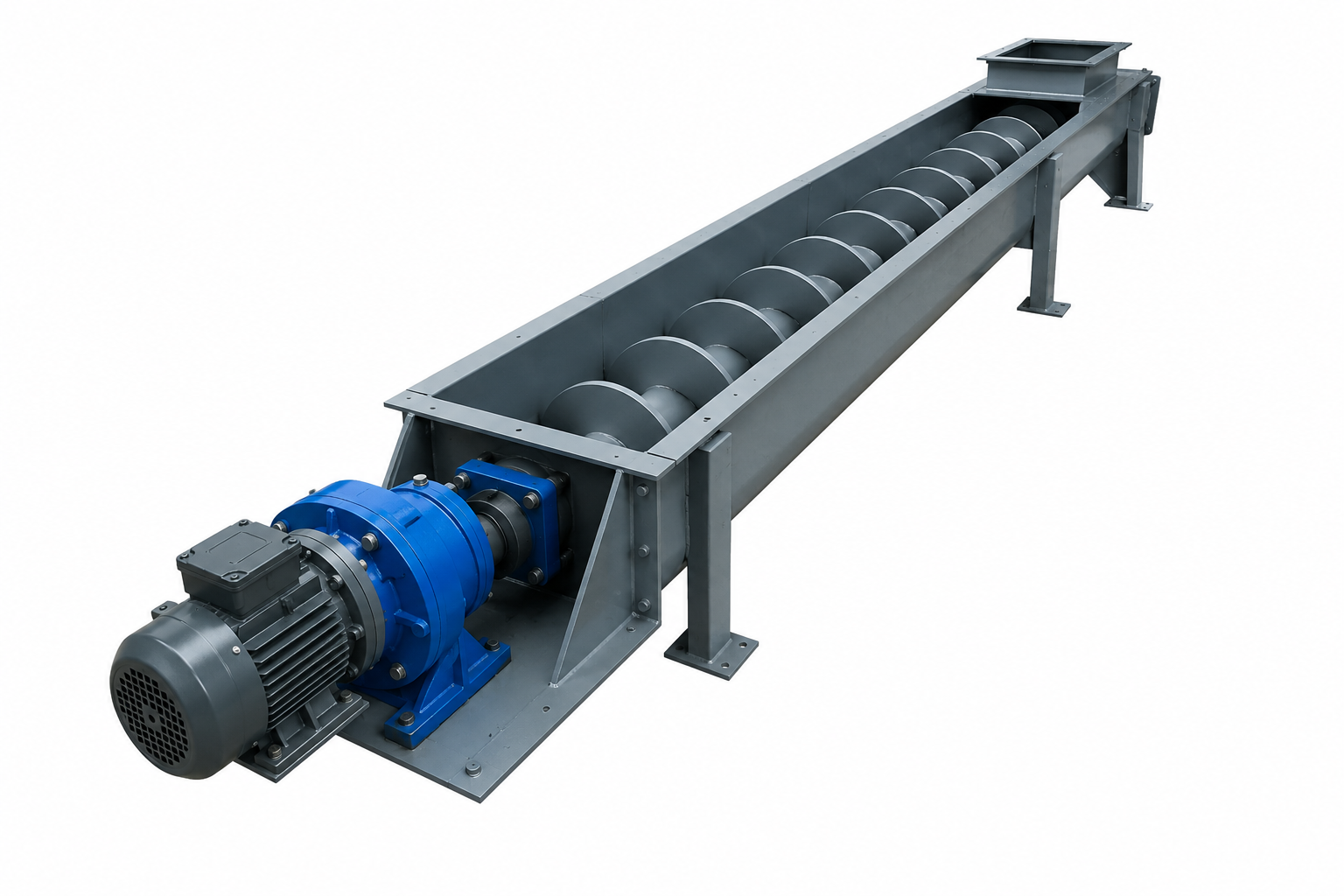
Screw Conveyor systems play an important role in food processing facilities where powders, grains, spices, flour, sugar, and other bulk ingredients need to be transferred efficiently. Food manufacturers require material handling equipment that supports consistent production while helping maintain product quality, cleanliness, and controlled material movement. A properly designed screw conveyor can provide a practical solution for moving bulk food materials between different stages of processing.
Screw conveyors use a rotating helical flight to push material through a trough or tube. This makes them particularly useful for controlled transportation of dry and semi-dry bulk materials.
Efficient Movement of Food Ingredients
Food processing plants often handle large quantities of ingredients throughout the production cycle. Flour may need to move toward mixing equipment, grains may be transferred between processing stages, and powdered ingredients may need to reach batching or packaging areas.
A Screw Conveyor provides a continuous transportation route, helping reduce unnecessary manual movement. Its controlled conveying action can also support consistent feeding of materials into downstream equipment.
This is particularly useful in high-volume production environments where maintaining a steady material flow is essential.
Suitable for Powders and Granular Materials
One of the key advantages of screw conveyors is their suitability for many bulk solid materials. Food processing applications can include flour, sugar, spices, grains, coffee, cocoa, protein powders, and other granular or powdered ingredients.
The conveyor can be configured according to material characteristics, required capacity, conveying distance, and production requirements. Selecting the correct screw design and operating conditions is important because different food materials can behave differently during transportation.
Supporting Controlled Material Flow
Accurate and consistent ingredient movement is important in food production. Variations in material supply can affect mixing, processing, and packaging operations.
A Screw Conveyor can provide controlled material transfer and can be incorporated into feeding and dosing processes. When paired with suitable speed controls and correctly selected components, the system can help maintain a consistent supply of ingredients to production equipment.
This can contribute to smoother workflows and improved production consistency.
Enclosed Material Transportation
Food processing environments need to control exposure to dust, moisture, and external contaminants. Enclosed screw conveyor configurations can help keep materials contained during transportation.
The enclosed design can also reduce the possibility of material spillage around the production area. However, the conveyor must still be designed for the specific sanitation and cleaning requirements of the food application.
Food-grade screw conveyors are commonly manufactured with corrosion-resistant stainless steel and smooth, cleanable surfaces where hygienic handling is required.
Reducing Manual Handling
Manual transportation of ingredients can increase labour requirements and create inconsistencies in production workflows. Workers may need to repeatedly carry bags or containers between storage and processing areas.
A Screw Conveyor automates this repetitive transportation. Employees can instead focus on production monitoring, quality checks, equipment operation, and other important tasks.
Reducing manual handling can also help businesses organize material movement more efficiently within the facility.
Supporting Cleaner Food Processing Operations
Cleanability is a major consideration when selecting conveying equipment for food applications. Material buildup and difficult-to-access areas can make cleaning more challenging and may increase the risk of cross-contamination.
For this reason, food processing applications may require specially designed screw conveyors with appropriate materials, seals, surfaces, covers, and access arrangements. Food-grade systems can be designed with features intended to make cleaning and inspection easier.
Businesses should select equipment according to their actual sanitation requirements rather than assuming that every screw conveyor is automatically suitable for food processing.
Saving Valuable Production Space
Food processing plants often contain mixers, grinders, storage systems, packaging equipment, and other machinery within limited floor areas. A screw conveyor can provide a relatively compact method of transferring bulk materials between process points.
Depending on the design, screw conveyors can operate horizontally or at an incline, providing flexibility when connecting different equipment or levels.
This can help businesses create more organized production layouts.
Supporting Different Food Processing Applications
A Screw Conveyor can be used at various stages of food production, including:
- Grain transportation
- Flour handling
- Sugar transfer
- Spice handling
- Powder ingredient feeding
- Coffee processing
- Animal feed production
- Bulk ingredient transfer
- Processing and packaging operations
The appropriate conveyor design depends on the material properties, capacity, required conveying distance, sanitation requirements, and facility layout.
Businesses looking for a dedicated screw conveying solution can explore Tech Trek Engineering’s product page:
Conclusion
A Screw Conveyor can be an effective material handling solution for food processing applications where dry powders, grains, and granular ingredients need to be transported in a controlled manner. Its ability to provide continuous material movement, reduce manual handling, support enclosed transportation, and fit into compact production layouts makes it valuable for many food processing operations.
However, choosing the right system requires careful consideration of material characteristics, throughput, cleaning requirements, and operating conditions. With appropriate design, installation, and maintenance, a screw conveyor can support efficient and reliable food processing operations.
Frequently Asked Questions
1. What food materials can a screw conveyor transport?
Depending on the design, screw conveyors can handle materials such as flour, sugar, spices, grains, coffee, powders, and other suitable bulk food ingredients.
2. Is a screw conveyor suitable for food processing?
Yes, screw conveyors can be designed for food processing applications. Food-grade configurations may use corrosion-resistant materials and cleanable designs appropriate to the required hygiene level.
3. How does a screw conveyor improve food processing efficiency?
It provides continuous and controlled movement of bulk ingredients, reducing repetitive manual transportation and helping maintain consistent material flow.
4. Can screw conveyors handle powdered ingredients?
Yes. Screw conveyors are commonly used for suitable powders and granular materials, although the conveyor configuration should be selected according to the specific characteristics of the material.
5. What should businesses consider before choosing a screw conveyor?
Important factors include material characteristics, required capacity, conveying distance, conveyor orientation, sanitation requirements, available space, and cleaning procedures.