
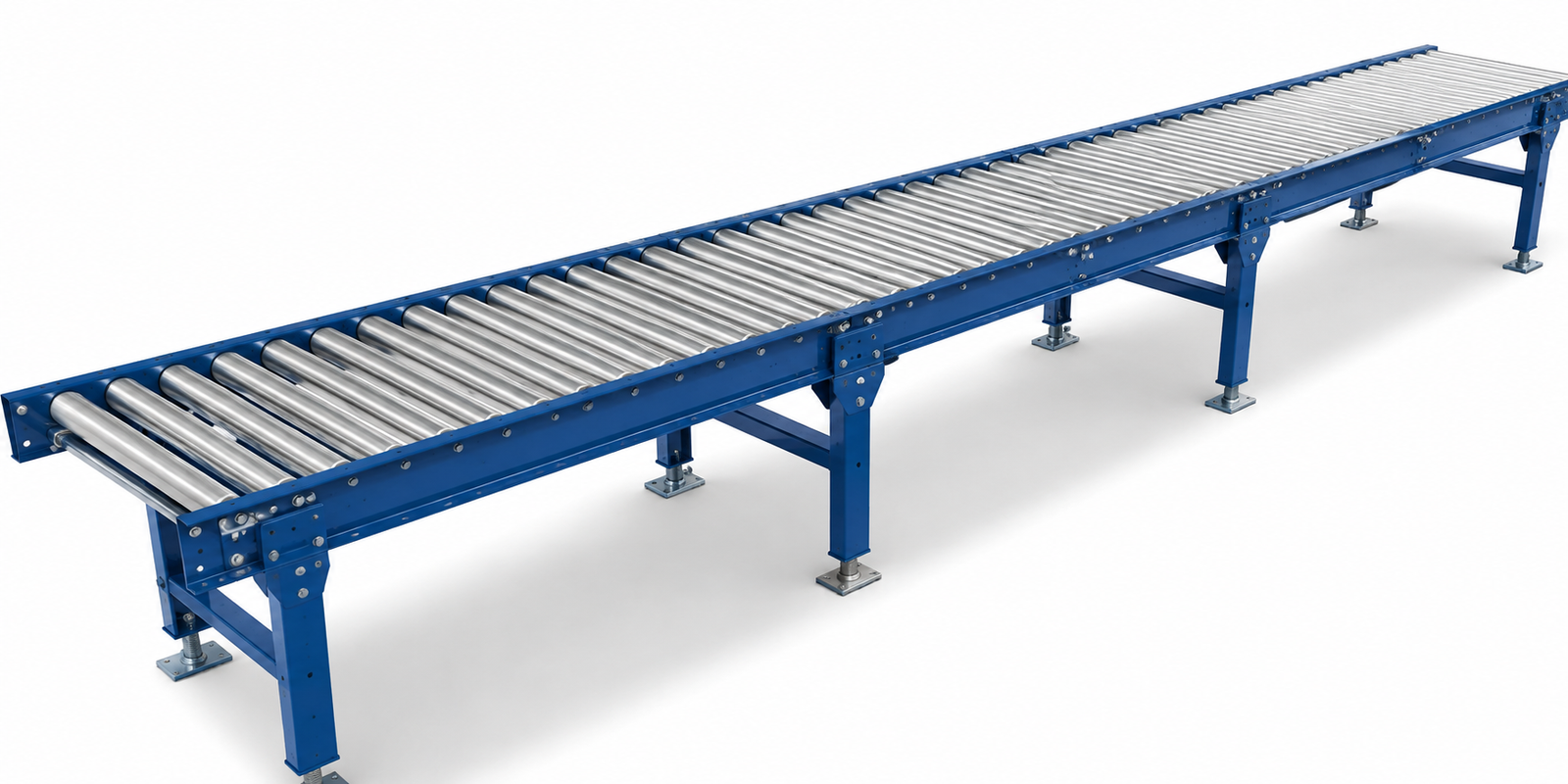
Gravity roller conveyor systems provide a simple and efficient way to move cartons, boxes, packages, and other unit loads across warehouses, distribution centers, manufacturing facilities, and packaging areas. By using rollers and natural gravitational force, these conveyors can transport products between different points without requiring a motor-driven system for every movement.
For businesses looking for practical material handling solutions, gravity roller conveyors can help simplify workflows, reduce repetitive manual movement, and improve the organization of carton and box transportation.
Smooth Carton and Box Movement
Cartons and boxes often need to travel between receiving areas, storage locations, packing stations, and dispatch sections. Carrying these products manually can consume time and create unnecessary movement.
A gravity roller conveyor provides a defined path for cartons to move along. When the conveyor is installed with an appropriate slope, gravity helps move the products from a higher point toward a lower point.
This makes the system particularly useful for applications where boxes need to move repeatedly between nearby workstations.
Reducing Manual Material Handling
Manual handling of cartons can become demanding when businesses process large volumes of packages. Employees may need to repeatedly lift, push, or carry boxes throughout the facility.
A gravity roller conveyor reduces the need for this repetitive transportation. Workers can place cartons onto the rollers and guide them toward the required destination.
This can improve workforce utilization while allowing employees to focus on packing, inspection, sorting, inventory management, and other operational tasks.
Supporting Warehouse Operations
Warehouses often require flexible equipment that can handle different carton sizes and support changing workflows. Gravity roller conveyors can be incorporated into receiving, packing, sorting, storage, and dispatch areas.
They can help establish organized transportation routes between different sections of a warehouse. This can reduce unnecessary walking and make product movement more systematic.
For businesses with straightforward carton-handling requirements, a gravity conveyor can be a practical addition to an existing material handling setup.
Cost-Effective Material Handling
One of the main advantages of a gravity roller conveyor is its relatively simple operating principle. Because gravity provides much of the movement, applications that do not require powered transportation may not need a motorized conveyor system.
This can help businesses control equipment and operating costs for suitable applications. However, the conveyor should be selected according to carton weight, dimensions, surface condition, required movement, and facility layout.
A properly matched system can provide efficient transportation without unnecessary mechanical complexity.
Suitable for Different Carton Sizes
Cartons and boxes can vary significantly in dimensions and weight. Conveyor selection should therefore consider the characteristics of the products being handled.
Roller spacing, conveyor width, load capacity, and frame construction can be selected according to the application. Closely spaced rollers can provide better support for smaller packages, while suitable roller configurations can accommodate larger cartons.
This flexibility allows gravity roller conveyors to be adapted to different warehouse and packaging requirements.
Improving Packing and Dispatch Workflows
Packaging and dispatch operations depend on efficient product movement. After a product is packed, it may need to move toward labelling, inspection, sorting, staging, or loading areas.
A gravity roller conveyor can connect these stages and help create a smoother workflow. Employees can push or guide boxes along the conveyor rather than carrying them between workstations.
This can reduce unnecessary movement and help maintain an organized packing and dispatch area.
Easy Integration Into Existing Workflows
Gravity roller conveyors can be used as standalone systems or incorporated into larger material handling layouts. They can connect workstations, storage areas, packing stations, and loading zones according to the requirements of a facility.
Their straightforward design can also make them suitable for businesses that want to improve material handling gradually rather than introducing a complex automated system immediately.
Businesses can explore Tech Trek Engineering’s Gravity Roller Conveyor solution for carton and box handling applications.
Maintenance and Long-Term Reliability
Although gravity roller conveyors have a relatively simple design, regular maintenance is still important for reliable operation. Rollers should be inspected for damage, excessive wear, or restricted movement.
The conveyor frame, bearings, supports, and connections should also be checked periodically. Keeping the rollers clean can help ensure that cartons move smoothly along the conveying surface.
Preventive maintenance can reduce unexpected interruptions and help maintain consistent performance.
Conclusion
A gravity roller conveyor is an effective option for businesses that need to move cartons and boxes efficiently through warehouses, packaging facilities, manufacturing plants, and distribution centers. Its simple operating principle, reduced manual handling requirements, flexible configuration, and suitability for different unit loads make it a practical material handling solution.
By selecting the appropriate roller spacing, conveyor dimensions, load capacity, and layout, businesses can create a more organized product movement system. With regular inspection and maintenance, gravity roller conveyors can support dependable carton and box handling over the long term.
Frequently Asked Questions
1. What is a gravity roller conveyor used for?
A gravity roller conveyor is commonly used to transport cartons, boxes, packages, totes, and other unit loads between different areas of a facility.
2. How does a gravity roller conveyor move cartons?
It typically uses gravity when installed on a suitable incline. Operators can also manually push or guide cartons along the rollers when required.
3. Is a gravity roller conveyor suitable for warehouses?
Yes. It can be useful for receiving, packing, sorting, staging, storage, and dispatch applications where cartons and boxes need to be moved between workstations.
4. Can gravity roller conveyors handle different box sizes?
Yes, provided the conveyor is properly designed. Roller spacing, width, load capacity, and configuration should be selected according to the dimensions and weight of the cartons.
5. Does a gravity roller conveyor require a motor?
Not necessarily. Gravity roller conveyors are designed to use gravity or manual force for movement, making them suitable for applications that do not require powered conveying.
6. How can businesses maintain a gravity roller conveyor?
Regularly inspect rollers, bearings, frames, supports, and connections. Keeping the rollers clean and replacing worn components promptly can help maintain smooth operation.