
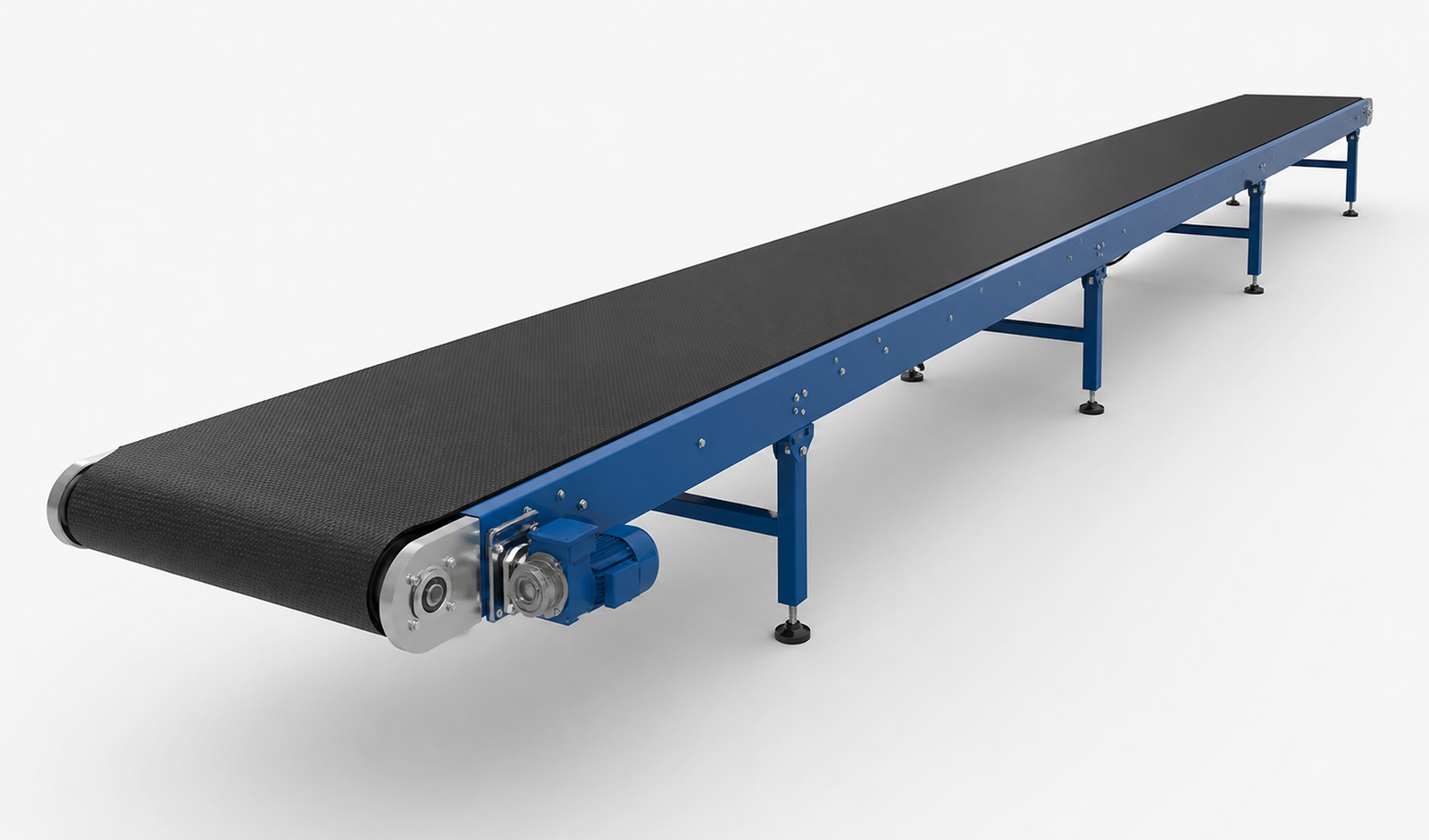
Flat belt conveyor systems are an essential part of modern packaging and assembly lines, offering a reliable and efficient solution for transporting products through different stages of production. Industries such as food processing, pharmaceuticals, electronics, automotive, logistics, and consumer goods manufacturing depend on flat belt conveyors to maintain a smooth workflow, reduce manual handling, and improve overall productivity. Their simple design, consistent performance, and versatility make them one of the most widely used conveyor systems in industrial applications.
As businesses continue to automate production processes, investing in a high-quality flat belt conveyor helps improve operational efficiency while ensuring products move safely and accurately from one workstation to the next.
What Is a Flat Belt Conveyor?
A flat belt conveyor is a conveyor system that uses a continuous flat belt stretched over rollers or pulleys to transport materials or products. It is designed to move items smoothly across horizontal or slightly inclined surfaces, making it suitable for handling a wide variety of products.
Flat belt conveyors are commonly used to transport:
- Cartons
- Boxes
- Packaged goods
- Industrial components
- Electronic products
- Food items
- Pharmaceutical products
- Consumer goods
Because of their versatility, they are used across numerous industries that require consistent and reliable product movement.
Why Packaging and Assembly Lines Need Flat Belt Conveyors
Packaging and assembly operations require products to move efficiently between multiple workstations. Delays in transportation can slow production and reduce overall output.
A flat belt conveyor provides continuous product movement, allowing packaging, labeling, inspection, and assembly processes to operate without interruption. This improves coordination between different stages of production and helps businesses meet high-volume manufacturing demands.
By automating product transportation, companies can increase productivity while maintaining consistent product quality.
Improving Production Efficiency
Efficient material movement is critical to successful manufacturing. Manual transportation between workstations can create bottlenecks and increase production time.
A flat belt conveyor helps eliminate these challenges by providing a steady flow of products throughout the production line.
Key advantages include:
- Continuous product movement
- Faster production cycles
- Reduced waiting time
- Better workflow management
- Increased production capacity
These benefits enable manufacturers to optimize resources and improve operational performance.
Supporting Accurate Assembly Operations
Assembly lines require precise movement of products so workers and automated equipment can perform their tasks efficiently.
A flat belt conveyor transports products at a controlled speed, allowing assembly operations to remain organized and consistent. Stable product movement reduces handling errors while supporting higher assembly accuracy.
Whether assembling automotive components, electronic devices, or consumer products, conveyor automation improves production consistency.
Enhancing Packaging Performance
Packaging is one of the final stages before products reach customers. Efficient packaging operations are essential for meeting delivery schedules and maintaining product quality.
A flat belt conveyor helps packaging facilities by transporting products smoothly between filling, sealing, labeling, inspection, and packing stations.
The result includes:
- Faster packaging speed
- Improved packaging consistency
- Reduced product handling
- Better workflow coordination
- Increased operational efficiency
Automated transportation minimizes delays and helps businesses handle larger production volumes.
Reducing Manual Material Handling
Manual transportation of products requires additional labor and increases the possibility of workplace fatigue and product damage.
Installing a flat belt conveyor reduces repetitive handling tasks, allowing employees to focus on quality control, machine operation, and process monitoring.
Benefits include:
- Lower labor costs
- Reduced employee fatigue
- Improved workforce productivity
- Better utilization of human resources
- Safer working conditions
Automation supports long-term operational efficiency while improving employee safety.
Supporting Industrial Automation
Modern manufacturing facilities rely on automation to improve consistency and reduce production costs.
A flat belt conveyor integrates easily with various automated systems, including:
- Packaging machines
- Labeling equipment
- Barcode scanners
- Robotic arms
- Inspection systems
- Sorting equipment
This integration creates a streamlined production environment where products move automatically through different manufacturing stages with minimal human intervention.
Reliable Performance and Easy Maintenance
Industrial equipment must operate consistently under demanding conditions.
A well-designed flat belt conveyor is built for durability and long service life. With routine maintenance, businesses can minimize downtime and maximize operational performance.
Regular maintenance includes:
- Inspecting the conveyor belt
- Checking rollers and pulleys
- Maintaining belt tension
- Cleaning conveyor surfaces
- Lubricating moving components where required
Preventive maintenance helps ensure smooth operation while extending the life of the equipment.
Applications Across Multiple Industries
The versatility of a flat belt conveyor makes it suitable for many industrial sectors.
Common applications include:
- Manufacturing
- Packaging
- Warehousing
- Logistics
- Food processing
- Pharmaceuticals
- Electronics
- Automotive
- Consumer goods production
Its ability to transport products efficiently makes it one of the most widely used conveyor systems in industrial facilities.
Choosing the Right Flat Belt Conveyor
Selecting the appropriate conveyor depends on factors such as product dimensions, load capacity, production speed, and facility layout.
Businesses looking for reliable conveyor solutions can explore:
The flat belt conveyor systems are engineered to deliver dependable performance, improve production efficiency, and support modern material handling requirements across diverse industries.
Conclusion
A flat belt conveyor is an ideal solution for packaging and assembly lines because it provides continuous product movement, improves production efficiency, reduces manual handling, and supports industrial automation. Its versatility allows manufacturers to transport products safely and consistently while optimizing workflow across different production stages.
As industries continue to increase production capacity and adopt automation, investing in a high-quality flat belt conveyor helps businesses improve operational efficiency, reduce costs, and maintain a competitive advantage. With reliable performance and long-term durability, it remains an essential component of modern manufacturing and packaging operations.
Frequently Asked Questions
1. What is a flat belt conveyor?
A flat belt conveyor is a material handling system that uses a continuous flat belt to transport products smoothly between different production or processing stages.
2. Which industries commonly use flat belt conveyors?
Flat belt conveyors are widely used in manufacturing, packaging, warehousing, logistics, food processing, pharmaceuticals, electronics, automotive, and consumer goods industries.
3. Why is a flat belt conveyor suitable for packaging lines?
It provides continuous and stable product movement, allowing packaging equipment and operators to work efficiently without interruptions.
4. Can a flat belt conveyor support assembly operations?
Yes. It transports products at a controlled speed, helping workers and automated systems perform assembly tasks accurately and efficiently.
5. Does a flat belt conveyor reduce labor costs?
Yes. It automates product transportation, reducing manual handling and allowing employees to focus on higher-value production activities.
6. What maintenance does a flat belt conveyor require?
Routine maintenance includes inspecting the belt, checking rollers and pulleys, maintaining proper belt tension, cleaning the conveyor, and performing preventive servicing.
7. Why should businesses invest in a flat belt conveyor?
A flat belt conveyor improves material handling efficiency, increases productivity, supports automation, enhances workplace safety, and delivers reliable long-term performance.