Description
Introduction:
A gravity roller conveyor is a simple, efficient, and cost-effective material handling system that uses gravity or manual force to move goods from one point to another. It is widely used in warehouses, logistics centers, manufacturing plants, and packaging areas where products need to be transferred without powered assistance. Gravity roller conveyors are valued for their low operating cost, minimal maintenance, and flexible installation options.
At Tech Trek Engineering, we design and manufacture high-quality gravity roller conveyors that are robust, reliable, and customized to suit different load types, sizes, and site layouts. Our systems are engineered to ensure smooth product flow, safe handling, and long service life.
What is a Gravity Roller Conveyor?
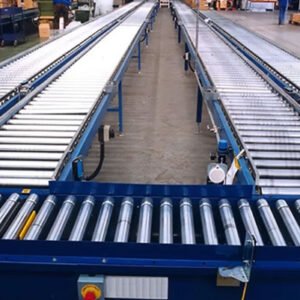
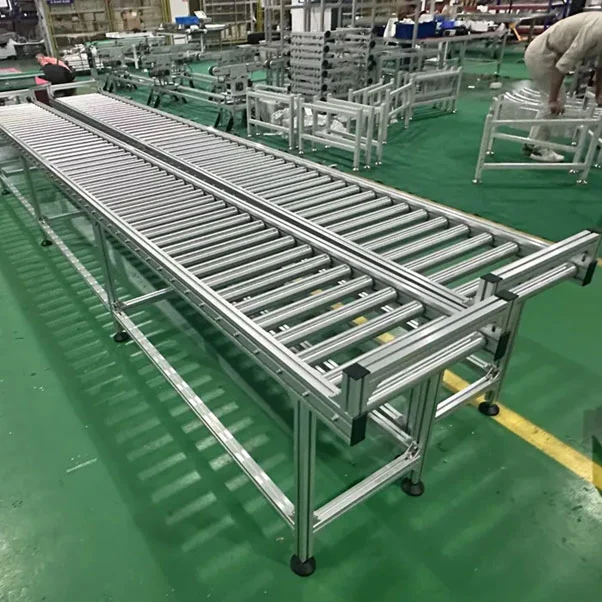
A gravity roller conveyor is a conveyor system consisting of a series of rollers mounted in a frame, where products move forward by gravity or manual push. The conveyor is usually installed at a slight incline so that cartons, boxes, or pallets roll naturally toward the discharge end.
Since gravity roller conveyors do not use motors or electrical power, they are an economical solution for material transfer in many industrial and commercial applications.
Working Principle:
The working principle of a gravity conveyor roller is straightforward:
- Products are placed on the rollers at the loading end.
- The conveyor is set at a small incline or used with manual push.
- Gravity causes the product to roll forward along the rollers.
- The rollers rotate freely, allowing smooth movement.
- The product reaches the discharge end for further processing or storage.
This simple mechanism ensures reliable material flow with minimal energy consumption.
Key Features of Gravity Roller Conveyors:
- No power or motor required
- Simple and robust construction
- Low operating and maintenance cost
- Smooth and controlled product movement
- Flexible installation and layout options
- Suitable for a wide range of product sizes
- Long service life
- Easy to expand or reconfigure
Types of Gravity Roller Conveyor:
Based on application and load requirements, gravity roller conveyors can be designed as:
- Straight gravity roller conveyor
- Inclined gravity roller conveyor
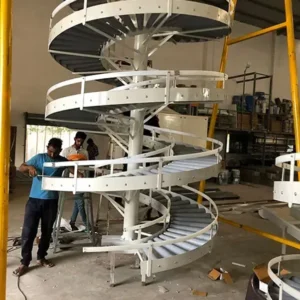
- Curved gravity roller conveyor
- Gravity roller conveyor with side guides
- Heavy-duty gravity roller conveyor
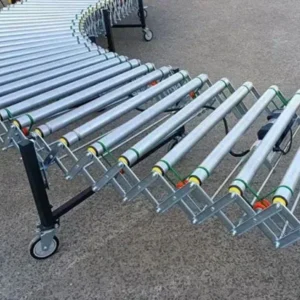
- Telescopic gravity roller conveyor
Each type is customized according to material characteristics and operational needs.
Roller Options:
We offer different roller types to suit various applications:
- Mild steel rollers
- Stainless steel rollers
- PVC-coated rollers
- Nylon rollers
- Heavy-duty rollers with precision bearings
Roller diameter, spacing, and load capacity are selected based on product weight and size.
Applications of Gravity Roller Conveyors:
Gravity roller conveyors are widely used in:
- Warehouses and distribution centers
- Logistics and courier hubs
- Packaging and dispatch areas
- Assembly and inspection lines
- E-commerce fulfilment centers
- Manufacturing plants
- Loading and unloading zones
They are ideal for handling cartons, boxes, totes, crates, and pallets.
Advantages of Gravity Roller Conveyors:
- Zero energy consumption
- Cost-effective material handling solution
- Easy installation and relocation
- Minimal maintenance requirement
- Improves workflow efficiency
- Reduces manual lifting and handling
- Reliable and durable design
Customization Options:
We provide complete customization, including:
- Conveyor length and width
- Roller type and diameter
- Adjustable height and incline
- Side guides and end stops
- Curved and modular sections
- Integration with powered conveyors
Gravity Roller Conveyor – FAQs:
Q1. What products are suitable for a gravity conveyor roller?
Cartons, boxes, totes, crates, and pallets with a flat bottom are ideal for gravity roller conveyors.
Q2. Does a gravity roller conveyor require electricity?
No, it operates using gravity or manual force and does not require electrical power.
Q3. How much incline is required for smooth movement?
The incline depends on product weight, roller type, and surface condition, and is designed accordingly.
Q4. Can gravity roller conveyors handle heavy loads?
Yes, with proper roller diameter and frame design, they can handle heavy-duty loads.
Q5. What factors affect the price of a gravity roller conveyor?
Price depends on conveyor length, width, roller type, load capacity, and customization.
Q6. Can gravity roller conveyors be combined with powered conveyors?
Yes, they are often integrated with powered roller or belt conveyors.
Q7. Do you provide installation support?
Yes, we provide technical guidance and installation support during commissioning.