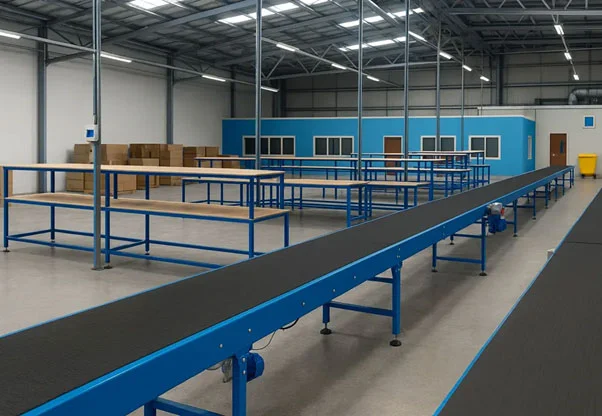
Description
Leading Flat Belt Conveyor Manufacturers
A flat belt conveyor system is one of the most widely used material handling equipment across industries. It is designed to transport materials smoothly, efficiently, and safely from one point to another. Due to its simple construction, versatility, and low maintenance requirements, flat belt conveyors are an ideal solution for both light-duty and heavy-duty applications.
Flat belt conveyors are commonly used for handling cartons, boxes, bags, components, and packaged goods in manufacturing units, warehouses, and processing plants. At Tech Trek Engineering, one of the leading conveyor manufacturers in India, we produce high-quality flat belt conveyors that are engineered for durability, precision, and long-term performance. Each system is custom designed to meet the specific operational needs of our customers.
What is a Flat Belt Conveyor?
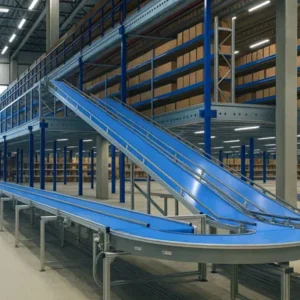
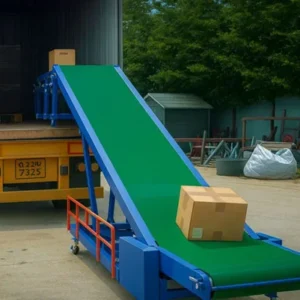
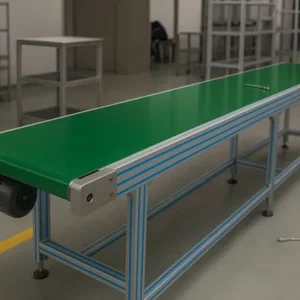
A flat belt conveyor is a conveyor system that uses a continuous, flat looped belt stretched over drive and end pulleys to carry products from one point to another. The belt is supported by rollers or a slider bed, and it can run horizontally or at a slight incline.
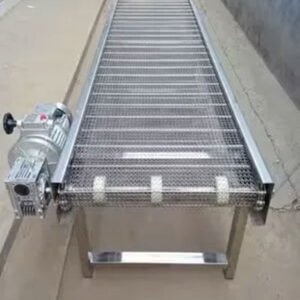
A typical system consists of the belt, drive and end pulleys, support rollers or slider bed, a geared motor and a control system, all mounted on a rigid frame. Because of this simple construction, flat belt conveyors are easy to install, easy to maintain and suitable for a wide range of products.
Working Principle:
- A geared motor drives the head pulley.
- The belt, tensioned over the drive and end pulleys, moves in a continuous loop.
- Products are placed on the belt at the loading point.
- Rollers or a slider bed support the belt so products travel smoothly along the conveyor.
- Belt speed is set manually or controlled through a VFD or PLC to match the process.
- Products are discharged at the end of the conveyor or passed on to the next station or conveyor.
Key Features of Flat Belt Conveyor:
- Smooth and controlled product movement
- Belt options for different products, including PVC, PU, rubber and rough top
- Variable speed control using VFD
- Custom length and width, with belt widths from 200 mm to 1500 mm
- Adjustable height structure, side guards and guide rails
- Food-grade or corrosion-resistant finishes available
- Minimal maintenance requirements
- Easy integration with existing conveyor systems
Belt Material Options:
Depending on application and industry requirements, we as one of the most renowned flat belt conveyor manufacturers offer the following options:
- PVC flat belt
- PU flat belt (food-grade)
- Rubber flat belt
- Rough top belt for better grip
- Oil-resistant and heat-resistant belts
When buying from Belt Conveyor Systems Manufacturers, the selection depends on factors such as material characteristics, temperature, friction requirement, and hygiene standards.
Applications:
Uses Of Flat Belt Conveyor :
- Manufacturing plants
- Packaging and assembly lines
- Warehouses and distribution centers
- Food and beverage industries
- Pharmaceutical industries
- Automotive and engineering industries
- FMCG and consumer goods handling
- E-commerce logistics and fulfilment centres
They are ideal for inspection lines, packing stations, and material transfer operations.
Advantages of Flat Belt Conveyor:
- Reduces manual labour and handling time
- Improves productivity and operational efficiency
- Ensures smooth and controlled product movement
- Minimizes product damage during transfer
- Enhances workplace safety
- Cost-effective and reliable solution
Customization Options:
We as conveyor Suppliers provide complete customization, including:
- Conveyor length and width modification
- Variable speed control using VFD
- Adjustable height structure
- Side guards and guide rails
- Center guide for belt alignment
- Food-grade or corrosion-resistant finishes
- Integration with existing conveyor systems
Ensure smooth material handling and improved operational efficiency with professional conveyor installation services tailored to your facility’s needs.
Flat Belt Conveyor – FAQs:
Q1. What materials can this conveyor handle?
Flat belt conveyors can handle cartons, boxes, bags, components, and packed goods. The belt type is selected based on material characteristics.
Q2. What factors affect the price of this conveyor?
Price depends on conveyor dimensions, belt material, load capacity, drive system, and level of customization.
Q3. Can flat belt conveyors be used in food industries?
Yes, food-grade PU belts and stainless-steel structures are available for hygienic applications.
Q4. Is variable speed control available?
Yes, variable speed operation can be provided using VFD or PLC-based control systems.
Q5. What is the maximum load capacity of a flat belt conveyor?
Load capacity depends on belt type, structure design, motor power, and application requirements.
Q6. Do you provide installation support?
Yes, we provide installation guidance and technical support for proper commissioning.
Q7. How much maintenance is required?
Flat belt conveyors require minimal maintenance, mainly routine inspection, belt alignment checks, and bearing lubrication.
Q8. What is the difference between a flat belt and a troughed belt conveyor?
A flat belt conveyor carries individual items such as cartons, boxes and packaged goods on a flat surface, while a troughed belt conveyor has raised edges that form a trough, so it can carry loose bulk material without spilling.