
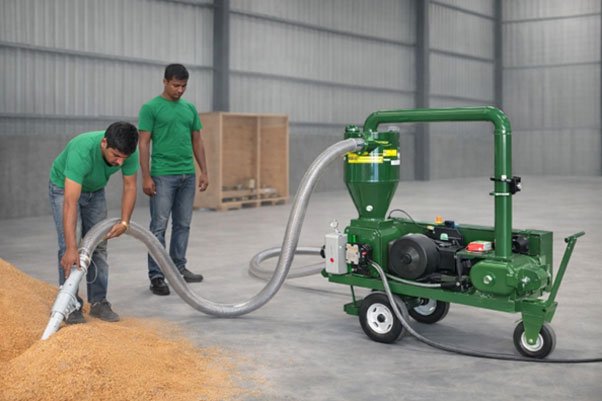
Description
Introduction:
A Pneumatic Conveyor is an advanced material handling system that transports bulk materials through pipelines using air or gas as the conveying medium. It is widely used for handling powders, granules, and fine materials in a clean, enclosed, and controlled manner. Pneumatic conveying systems are ideal for applications where hygiene, dust control, and flexible routing are critical.
At Tech Trek Engineering, we design and manufacture pneumatic conveyor systems that are efficient, reliable, and fully customized according to material properties, conveying distance, and plant layout. Our pneumatic conveyors are engineered for safe operation, minimal material loss, and consistent performance in demanding industrial environments.
What is a Pneumatic Conveyor?
A pneumatic conveyor is a conveying system that moves material through a closed pipeline using air pressure or vacuum. Instead of mechanical components like belts or screws, pneumatic conveyors rely on airflow to carry materials from one point to another.
These systems are especially suitable for transporting fine, dusty, or fragile materials while maintaining a clean and hygienic working environment.
Working Principle:
The working principle of a pneumatic conveyor depends on the conveying method:
Positive Pressure Pneumatic Conveying
- Material is fed into the conveying line through a feeder.
- Compressed air pushes the material through the pipeline.
- Material travels at controlled velocity.
- At the discharge point, air and material are separated using a cyclone or filter receiver.
Vacuum Pneumatic Conveying
- A vacuum source creates negative pressure in the pipeline.
- Material is sucked into the conveying line from the source.
- Material travels through the pipeline to the receiver.
- Material is discharged, and air is filtered before release.
Both systems ensure enclosed, dust-free material transfer.
Key Features of Pneumatic Conveyor:
- Fully enclosed and dust-free conveying
- Hygienic and clean operation
- Flexible routing with bends and vertical lifts
- Minimal material contamination
- Reduced spillage and product loss
- Suitable for long-distance conveying
- Automated and safe operation
- Customizable system design
Types of Pneumatic Conveying Systems:
Based on application and conveying method, pneumatic conveyors can be designed as:
- Positive pressure pneumatic conveyor
- Vacuum pneumatic conveyor
- Dilute phase pneumatic conveying
- Dense phase pneumatic conveying
- Centralized pneumatic conveying system
System selection depends on material properties, capacity, and conveying distance.
Material Handling Capability:
Pneumatic conveyors are suitable for handling:
- Powders
- Granules
- Fine particles
- Lightweight bulk materials
Examples include cement, flour, sugar, chemicals, plastic granules, fly ash, and pharmaceutical powders.
Applications of Pneumatic Conveyor:
Pneumatic conveyors are widely used in:
- Cement and construction material plants
- Food processing industries
- Pharmaceutical industries
- Chemical and fertilizer plants
- Plastic processing and polymer plants
- Power plants and fly ash handling
- Powder handling and batching systems
They are ideal for clean and controlled bulk material transfer.
Advantages of Pneumatic Conveyor:
- Completely enclosed and dust-free operation
- High level of hygiene
- Flexible installation with minimal space requirement
- Reduced manual handling
- Safe and automated operation
- Minimal material contamination
- Suitable for complex plant layouts
Customization Options:
We provide extensive customization options, including:
- Positive pressure or vacuum system selection
- Dilute or dense phase conveying
- Pipeline routing and layout design
- Food-grade or corrosion-resistant construction
- Automation and interlock systems
- Integration with silos, hoppers, and machines
Pneumatic Conveyor – FAQs:
Q1. What materials are suitable for pneumatic conveying?
Pneumatic conveyors are suitable for powders, granules, and fine bulk materials such as cement, flour, chemicals, and fly ash.
Q2. What is the difference between dilute phase and dense phase conveying?
Dilute phase uses high air velocity with low material concentration, while dense phase uses low velocity with high material concentration.
Q3. Is pneumatic conveying dust-free?
Yes, pneumatic conveying systems are fully enclosed and designed for dust-free operation.
Q4. Can pneumatic conveyors handle long distances?
Yes, pneumatic conveyors are suitable for long-distance and vertical conveying.
Q5. What factors affect the price of a pneumatic conveyor system?
Price depends on material type, conveying distance, capacity, system type, and level of automation.
Q6. Are pneumatic conveyors suitable for food and pharmaceutical industries?
Yes, with stainless steel and hygienic design, they are ideal for food and pharma applications.
Q7. Do you provide installation and commissioning support?
Yes, we provide complete technical guidance during installation and commissioning.