
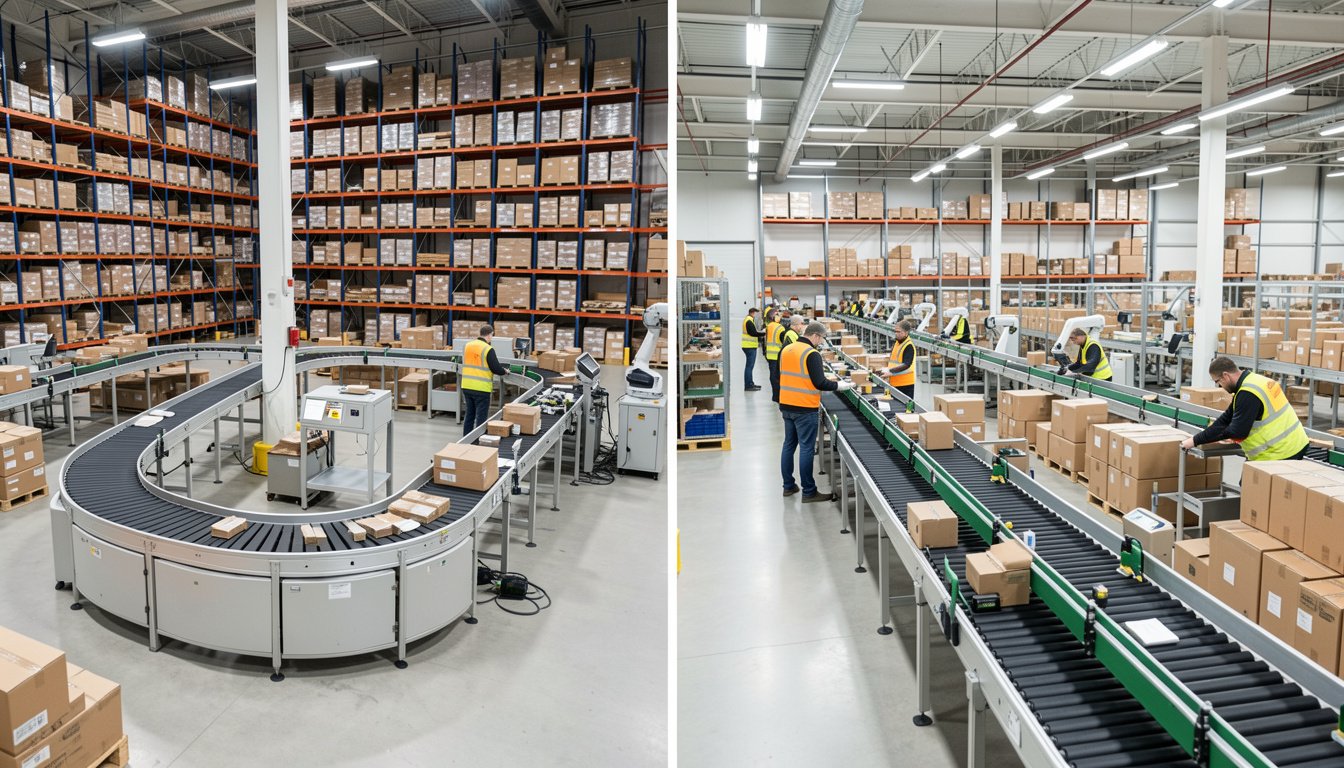
A modular belt conveyor system scales better for most e-commerce businesses as it offers flexibility, quick installation, and scale faster when order volumes grow. Fixed conveyor systems, on the other hand are more cost-effective and perform efficiently in high-volume operations with stable and long-term layouts. When it comes to choosing between the two, the right choice depends on growth speed, budget, and predictability in warehouses.
Table of Contents
Significance of Conveyor Scalability in E-Commerce
E-commerce sales and growth undergoes fluctuations. Furthermore, things like seasonal highs, flash sales, marketplace expansion and same-day delivery expectations create more pressure n warehouse operations. Conveyor systems play a crucial role in optimizing order fulfillment by improving picking speed, reducing dependency on labor, and ensuring accuracy.
Choosing the wrong conveyor system may lead to:
- Increased costs
- Operational bottlenecks
- Downtime during expansion
That’s why scalability is one of the most important decisions to consider when comparing modular vs fixed conveyor systems for e-commerce.
What are Modular and Fixed Conveyor Systems?
Modular Conveyor Systems
Modular conveyor systems are built using standardized and interchangeable components such as belts, rollers, curves, and frames. These components can be easily added, removed, or reconfigured.
Key Features:
- Convenient design
- Easy layout changes
- Faster installation
- Minimal structural modification
Applications:
- Transportation of components efficiently between assembly stations
- Moving products seamlessly within several storage facilities
- Easing packaging lines with flexible conveyor layouts
- Streamlines quick sorting and parcel distribution in e-commerce
- Ensure hygienic and reliable transportation of products
By using high-quality modular conveyor systems, businesses can improve operations stay competitive in fast-moving industries.
Fixed Conveyor Systems
Fixed conveyor systems come with custom design and meant for specific warehouse layout and throughput requirement. Once installed, modification can be difficult and expensive.
Key Features:
- Permanent installation
- Optimized for high throughput
- Longer setup time
- High structural integration
Applications:
- Ideal for large and stable e-commerce operations
- High-volume fulfillment centers
- Facilities with predictable order flow
Scalability Comparison: Modular vs Fixed Conveyor Systems
Here is a basic comparison between modular and fixed conveyor systems:
1. Flexibility and Expansion
A modular belt conveyor wins decisively when it comes to stability. With the growth of e-commerce business, you can extend conveyor lines, integrate new modules or add curves without major downtime.
A fixed conveyor system, on the other hand, lacks flexibility. Scaling often requires redesigning entire sections, strengthening floors or replacing the entire infrastructure, making expansion slow and expensive.
2. Installation and Downtime
Modular systems can be installed pretty fat and also in the midst of live operations and expansion usually causes little disruption.
For fixed systems, any upgrade will require a planned shutdown, affecting fulfillment timelines.
3. Cost Consideration
Upfront Cost
- Modular systems have higher initial cost per unit
- Fixed systems are cheaper upfront and meant for permanent and large layouts.
Long-Term Cost
- Modular systems reduce modification costs in the long run
- Fixed systems are expensive to scale or reconfigure
4. Throughput and Performance
Although efficient, modular conveyor systems have slightly lower maximum throughput compared to fully-customized fixed systems
Fixed systems are appropriate for handling very high volumes with consistent performance and designed for efficiency, making them ideal for large-scale operations.
5. Technology and Automation Upgradation
Both systems can integrate with:
- Warehouse Management Systems (WMS)
- Barcode scanners
- Sorters
- Robotics and AS/RS
However, modular conveyor systems make future automation upgrades easier as technology evolves.
Take a look at this quick snapshot:
| Criteria | Modular Conveyor Systems | Fixed Conveyor Systems |
| Scalability | Highly scalable and easy to expand with order volume growth | Limited scalability as expansion may require redesigning re replacement |
| Flexibility | Flexible and layout changes are quick and low-cost | Rigid and designed for a permanent layout |
| Installation Time | Fast installation with minimal downtime | Longer installation and may require operational shutdown |
| Upfront Cost | Moderate to high initial cost | Lower upfront cost |
| Long-term Cost | Lower total cost due to easy upgrades | Higher long-term costs due to modifications |
| Throughput Capacity | Suitable for low to medium-high volumes | Ideal for very high volume operations |
| Customization | Standardized components with modular add-ons | Fully customized to specific warehouse needs |
| Automation Integration | Easy integration with WMS, sorters, and robotics | Automation-friendly but harder to upgrade later |
| Maintenance | Easy to maintain | Maintenance may require system-wide intervention |
| Downtime during Expansion | Minimal or none | High |
| Best Use Case | Growing e-commerce, evolving warehouses, and 3PLs | Large, stable, and high-volume e-commerce facilities |
Which Conveyor System is best for Scaling E-commerce?
Choose Modular Conveyor Systems when:
- Your e-commerce business is growing rapidly
- You expect layout changes or SKU expansion
- You want automation in phases
- You operate in leased or temporary facilities
Choose Fixed Conveyor Systems when:
- Your order volume is consistently high
- Your warehouse layout is stable
- You prioritize maximum throughput
- You have long-term facility ownership
Final Thoughts
Choosing between modular and fixed conveyor systems ultimately comes down to how your e-commerce business plans to grow. When growth patterns shift quickly, investing in a conveyor system that aligns with your expansion strategy is critical. The right decision not only supports current operations but also ensures your fulfillment infrastructure is ready for the future. Scale smarter with Tech Trek, one of the renowned conveyor manufacturers in India and talk to our experts today to future-proof your e-commerce operations.
FAQs
Which conveyor system is better for scaling e-commerce operations?
Modular conveyor systems are better for scaling e-commerce because they allow quick expansion, layout changes, and phased automation as order volumes grow.
What is the main difference between modular and fixed conveyor systems?
The main difference is flexibility. Modular conveyor systems can be reconfigured easily, while fixed conveyor systems are permanently installed for stable, high-volume operations.
Are modular conveyor systems more expensive than fixed systems?
Modular systems may cost more upfront, but they usually offer lower long-term costs due to easier upgrades and reduced downtime during expansion.
When should an e-commerce business choose a fixed conveyor system?
Fixed conveyor systems are ideal when order volumes are consistently high, warehouse layouts are stable, and maximum throughput is required.