
Description
Introduction:
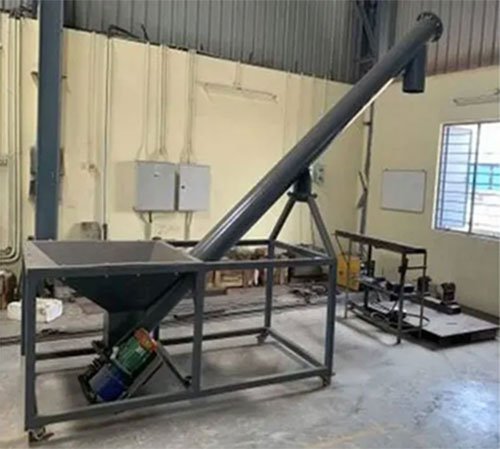
A Screw Conveyor is a highly efficient and compact material handling system designed to transport bulk materials using a rotating helical screw inside a trough or tube. It is widely used for conveying powders, granules, semi-solid materials, and small lumps over short to medium distances. Screw conveyors are valued for their simple construction, enclosed design, and ability to handle a wide variety of materials with controlled flow.
At Tech Trek Engineering, we design and manufacture robust screw conveyors that are customized according to material characteristics, capacity requirements, and installation conditions. Our screw conveyors are engineered for reliable performance, low maintenance, and long service life in demanding industrial environments.
What is a Screw Conveyor?
A screw conveyor is a mechanical conveying system that uses a rotating screw (also called a flight) mounted on a central shaft, enclosed within a trough or tubular casing. As the screw rotates, material moves forward along the conveyor due to friction between the material and the screw flights.
Screw conveyors are ideal for applications where dust control, precise material flow, and compact layout are important.
Working Principle:
The working principle of a screw conveyor is based on rotational motion:
- Material is fed into the conveyor inlet.
- A motor drives the screw through a gearbox.
- The rotating screw flights push the material forward along the casing.
- Material moves continuously toward the discharge outlet.
- The enclosed casing prevents spillage and dust emission.
The conveying speed and capacity are controlled by screw diameter, pitch, and rotational speed.
Key Features of Screw Conveyor:
- Compact and space-saving design
- Enclosed construction for dust-free operation
- Smooth and controlled material flow
- Suitable for continuous or batch operation
- Handles powders, granules, and semi-solid materials
- Low maintenance requirement
- Easy integration with other equipment
- Customizable configuration
Types of Screw Conveyors:
Although commonly referred to as a single product type, screw conveyors can be designed in different configurations based on application:
- Horizontal screw conveyor
- Inclined screw conveyor
- Vertical screw conveyor
- Shafted screw conveyor
- Shaftless screw conveyor
The configuration is selected based on material properties, conveying distance, and inclination angle.
Screw and Casing Options:
We offer various screw and casing designs to suit different materials:
- Screw Flight Types: Standard flight, cut flight, ribbon flight, paddle flight
- Shaft Material: Mild Steel / Stainless Steel
- Casing Type: U-trough / Tubular / Dust-tight casing
- Liner Options: Wear-resistant liners for abrasive materials
Proper selection ensures efficient conveying and long equipment life.
Applications of Screw Conveyor:
Screw conveyors are widely used in:
- Cement and construction material handling
- Food processing industries
- Flour mills and grain handling
- Chemical and fertilizer plants
- Pharmaceutical industries
- Ash and sludge handling
- Waste and by-product conveying
They are ideal for handling cement, powder, sand, ash, grains, chemicals, and similar materials.
Advantages of Screw Conveyor:
- Dust-free and clean operation
- Precise control over material flow
- Compact design suitable for tight spaces
- Low operating cost
- Reliable continuous operation
- Reduced material spillage
- Easy maintenance
Customization Options:
We provide extensive customization options, including:
- Screw diameter and pitch selection
- Shafted or shaftless design
- Inclined or vertical conveying
- Wear-resistant or food-grade construction
- Variable speed control using VFD
- Multiple inlet and discharge points
Screw Conveyor – FAQs:
Q1. What materials can be handled using a screw conveyor?
Screw conveyors are suitable for powders, granules, ash, sand, cement, grains, chemicals, and semi-solid materials.
Q2. What is the difference between shafted and shaftless screw conveyors?
Shafted screw conveyors are used for free-flowing materials, while shaftless screw conveyors are suitable for sticky or fibrous materials.
Q3. Can screw conveyors be installed at an incline?
Yes, screw conveyors can be installed at an incline, but capacity reduces as the inclination increases.
Q4. Are screw conveyors dust-proof?
Yes, screw conveyors have enclosed casings, making them ideal for dust-free operation.
Q5. What factors affect the price of a screw conveyor?
Price depends on screw diameter, length, material of construction, capacity, and customization.
Q6. Is speed control available for screw conveyors?
Yes, variable speed control can be provided using VFD or PLC systems.
Q7. Do you provide installation and commissioning support?
Yes, we provide complete technical guidance during installation and commissioning.