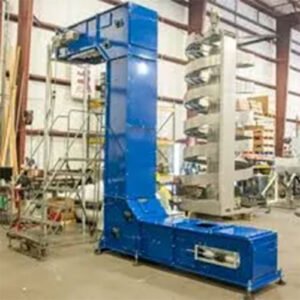
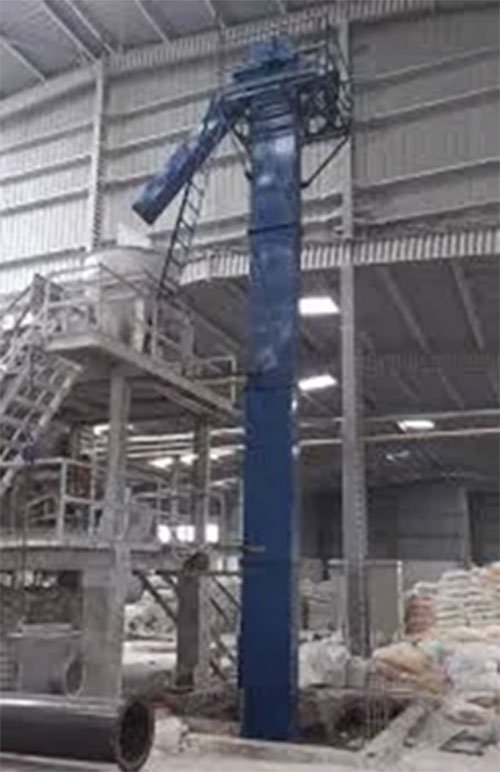
Description
Introduction:
A Bucket Elevator Conveyor is a vertical material handling system designed to lift bulk materials efficiently from a lower level to a higher level. It is widely used in industries where vertical transportation of powders, granules, and bulk solids is required in a compact space. Bucket elevators offer high capacity, continuous operation, and minimal spillage, making them an essential solution for modern industrial material handling.
At Tech Trek Engineering, we design and manufacture robust bucket elevators that are customized according to material characteristics, capacity requirements, and plant layout. Our bucket elevators are engineered for reliability, long service life, and consistent performance in demanding industrial environments.
What is a Bucket Elevator Conveyor?
A bucket elevator is a vertical conveyor system consisting of buckets attached to a belt or chain that moves around head and tail pulleys or sprockets. The buckets scoop material from the inlet point, carry it vertically, and discharge it at the top through centrifugal or gravity discharge.
Bucket elevators are ideal for handling bulk materials such as grains, cement, sand, coal, fertilizer, and similar products.
Working Principle:
The working principle of a bucket elevator is as follows:
- Material is fed into the inlet hopper at the bottom of the elevator.
- Buckets attached to a belt or chain scoop the material.
- The drive unit moves the belt or chain upward.
- Buckets carry the material vertically to the discharge point.
- Material is discharged at the top by centrifugal force or gravity.
- Empty buckets return to the inlet point to repeat the cycle.
This continuous operation allows efficient vertical material transfer with minimal space usage.
Key Features of Bucket Elevator:
- Efficient vertical material handling
- Compact design with minimal floor space requirement
- High conveying capacity
- Continuous and smooth operation
- Reduced material spillage
- Strong and durable construction
- Low power consumption
- Customizable design
Types of Bucket Elevator Conveyor:
Based on application and material characteristics, bucket elevators can be designed as:
- Belt type bucket elevator
- Chain type bucket elevator
- Centrifugal discharge bucket elevator
- Continuous discharge bucket elevator
- Heavy-duty bucket elevator
The selection depends on material flow behaviour, capacity, and operating conditions.
Bucket and Material Options:
We offer different bucket and construction options to suit various applications:
- Buckets made from Mild Steel, Stainless Steel, or Plastic
- Belts made from rubber, PVC, or fabric-reinforced materials
- Chains designed for heavy-duty applications
- Wear-resistant and corrosion-resistant materials
Bucket size and spacing are selected based on material density and required capacity.
Applications of Bucket Elevator:
Bucket elevators are widely used in:
- Cement plants
- Food grain and flour mills
- Fertilizer plants
- Power plants and coal handling
- Chemical industries
- Sugar plants
- Mining and mineral processing units
They are ideal for vertical transportation of powders, granules, and bulk solids.
Advantages of Bucket Elevator:
- Efficient vertical conveying solution
- High capacity with low energy consumption
- Minimal material loss
- Long service life
- Suitable for continuous operation
- Reduced manpower requirement
- Reliable performance
Customization Options:
We provide complete customization, including:
- Elevator height and capacity
- Bucket size and spacing
- Belt or chain selection
- Inlet and discharge design
- Dust-tight casing options
- Speed control using VFD
Bucket Elevator – FAQs:
Q1. What materials can be handled using a bucket elevator?
Bucket elevators are suitable for powders, granules, and bulk materials such as grains, cement, sand, coal, and fertilizer.
Q2. What is the difference between belt and chain bucket elevators?
Belt bucket elevators are used for lighter materials, while chain bucket elevators are suitable for heavy-duty and abrasive materials.
Q3. How is material discharged from a bucket elevator?
Material is discharged either by centrifugal force or gravity, depending on the design.
Q4. Can bucket elevators be used for continuous operation?
Yes, they are designed for continuous industrial operation.
Q5. What factors affect the price of a bucket elevator?
Price depends on elevator height, capacity, bucket type, belt or chain selection, and material of construction.
Q6. Are bucket elevators suitable for outdoor installation?
Yes, they can be designed for outdoor use with weather-resistant construction.
Q7. Do you provide installation and commissioning support?
Yes, we provide technical guidance and support during installation and commissioning.