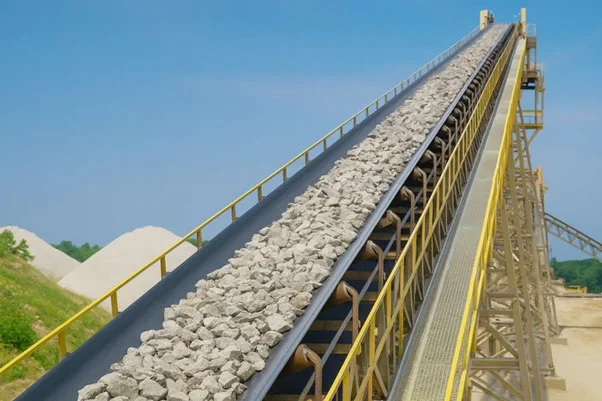
Description
Introduction:
A Rubber Belt Conveyor is a heavy-duty material handling system designed for transporting bulk materials and heavy loads under demanding industrial conditions. Known for its strength, durability, and resistance to wear, a rubber belt conveyor is widely used in industries where materials are abrasive, heavy, or conveyed over long distances.
At Tech Trek Engineering, we manufacture robust rubber belt conveyors that are engineered for continuous operation, high load capacity, and long service life. Each system is custom-designed to suit the specific material characteristics, capacity requirements, and site conditions of our customers.
What is a Rubber Belt Conveyor?
A rubber belt conveyor is a conveyor system that uses a rubber conveyor belt as the carrying medium. The belt runs over head and tail pulleys and is supported by idlers or a slider bed. Rubber belts are preferred in heavy-duty applications due to their excellent tensile strength, abrasion resistance, and ability to handle harsh operating environments.
Rubber belt conveyors can be designed for horizontal, inclined, or declined conveying and are suitable for both indoor and outdoor installations.
Working Principle:
The working principle of a rubber belt conveyor is simple and reliable:
- A geared motor drives the head pulley of the conveyor.
- The rotating head pulley moves the rubber belt forward.
- Material is loaded onto the belt at the feed point.
- The belt carries the material along the conveyor path.
- Material is discharged at the head end through gravity or chute systems.
- The belt returns on return idlers, completing a continuous loop.
This design ensures smooth, continuous, and efficient material transportation.
Key Features of Rubber Belt Conveyor:
- Heavy-duty construction for industrial use
- High tensile strength and load-carrying capacity
- Excellent abrasion and wear resistance
- Suitable for long-distance conveying
- Reliable performance in harsh environments
- Low operating and maintenance cost
- Designed for continuous operation
- Customizable configuration
Types of Rubber Belt Conveyors:
Based on application requirements, rubber belt conveyors can be designed as:
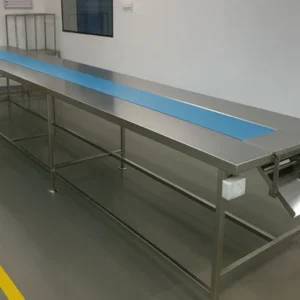
- Flat rubber belt conveyor
- Trough rubber belt conveyor
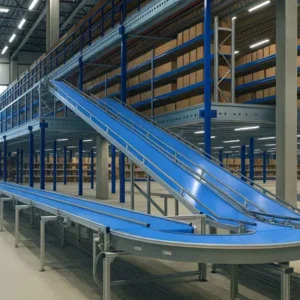
- Incline rubber belt conveyor
- Decline rubber belt conveyor
- Rubber belt conveyor with cleats
- Rubber belt conveyor with side walls
The design selection depends on material type, conveying distance, and incline angle.
Rubber Belt Types Available:
We offer a wide range of rubber belts to suit different operating conditions:
- Abrasion-resistant rubber belt
- Heat-resistant rubber belt
- Oil-resistant rubber belt
- Fire-resistant rubber belt
- Chevron rubber belt
- Heavy-duty rubber belt
Belt selection is based on material temperature, abrasiveness, and environmental conditions.
Applications of Rubber Belt Conveyor:
Rubber belt conveyors are widely used in:
- Cement plants
- Mining and mineral processing
- Power plants and coal handling
- Steel and metal industries
- Fertilizer plants
- Chemical industries
- Ports and bulk material terminals
- Construction material handling
They are ideal for handling coal, clinker, limestone, sand, ore, and other bulk materials.
Advantages of Rubber Belt Conveyor:
- High conveying efficiency
- Capable of handling heavy and abrasive materials
- Long service life
- Reduced material spillage
- Suitable for outdoor installation
- Lower manpower requirement
- Cost-effective for bulk material handling
Customization Options:
We offer full customization, including:
- Belt width and length customization
- Incline and decline design
- Cleats and side walls for material retention
- Variable speed control
- Weather-resistant coatings
- Integration with feeding and discharge systems
Rubber Belt Conveyor – FAQs:
Q1. What materials can be handled using a rubber belt conveyor?
Rubber belt conveyors are suitable for bulk materials such as coal, sand, clinker, limestone, ore, and minerals.
Q2. What is the difference between rubber belt and PVC belt conveyors?
Rubber belt conveyors are used for heavy-duty and abrasive materials, while PVC belts are typically used for lighter loads.
Q3. Can rubber belt conveyors be used outdoors?
Yes, they are commonly designed for outdoor operation with weather-resistant components.
Q4. How is belt life affected by material type?
Belt life depends on material abrasiveness, temperature, speed, and maintenance practices.
Q5. Is speed control available for rubber belt conveyors?
Yes, variable speed control can be provided using VFD or PLC systems.
Q6. What factors affect the price of a rubber belt conveyor?
Price depends on belt width, length, belt grade, load capacity, and structural design.
Q7. Do you provide installation and commissioning support?
Yes, we provide technical assistance during installation and commissioning.