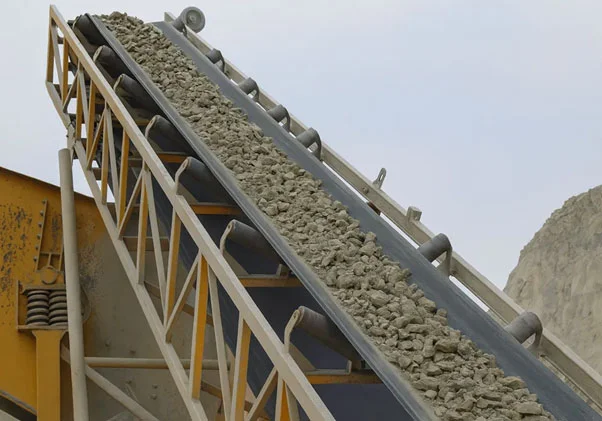
Description
Introduction:
A Troughed Belt Conveyor is a heavy-duty bulk material handling system designed to transport loose, granular, or powdered materials efficiently over long distances. Unlike flat belt conveyors, a trough belt conveyor uses specially arranged idler rollers to form the belt into a trough shape, which helps contain materials and prevent spillage during conveying.
Trough belt conveyors are widely used in industries such as mining, cement, power plants, steel plants, ports, and bulk material processing units. At Tech Trek Engineering, we manufacture robust and reliable trough belt conveyors that are engineered for high capacity, continuous operation, and demanding industrial environments.
What is a Troughed Belt Conveyor?
A troughed belt conveyor is a belt conveyor system in which the belt is supported by troughing idlers that shape the belt into a U-like profile. This trough shape increases material carrying capacity and ensures stable transportation of bulk materials.
The system consists of a continuous belt, head and tail pulleys, troughing idlers, return idlers, a drive unit, and a rigid supporting structure. The conveyor can be designed for horizontal, inclined, or slightly declined applications.
Working Principle:
The working principle of a troughed belt conveyor is as follows:
- The drive motor rotates the head pulley through a gearbox.
- The belt moves forward over troughing idlers, forming a trough shape.
- Bulk material is loaded onto the belt at the feed point.
- The trough shape holds the material securely during transportation.
- The material is discharged at the head end through gravity or discharge chutes.
- The empty belt returns on return idlers underneath the conveyor structure.
This design allows continuous, high-capacity material handling with minimal loss.
Key Features of Troughed Belt Conveyor:
- High material carrying capacity
- Designed for bulk and abrasive materials
- Reduced spillage due to trough profile
- Suitable for long-distance conveying
- Strong and durable structure
- Smooth and continuous operation
- Low operating cost per ton of material
- Designed for outdoor and indoor use
Troughing Angle Options:
The troughing angle plays a critical role in conveyor capacity and material stability. Common options include:
- 20° trough angle
- 30° trough angle
- 35° trough angle
- 45° trough angle (for special applications)
The selection depends on material flow characteristics, belt width, and capacity requirement.
Belt Options for Troughed Belt Conveyors:
We offer a wide range of belt types suitable for bulk material handling:
- Rubber belt conveyor (plain or textured)
- Oil-resistant rubber belts
- Heat-resistant belts
- Abrasion-resistant belts
- Fire-resistant belts
Belt selection is based on material type, temperature, abrasiveness, and operating conditions.
Applications of Troughed Belt Conveyor:<
Trough belt conveyors are extensively used in:
- Cement plants
- Power plants
- Steel and metal industries
- Mining and mineral processing
- Coal handling plants
- Fertilizer plants
- Ports and bulk loading terminals
- Chemical and process industries
They are ideal for handling materials such as coal, limestone, clinker, sand, ore, grains, and fertilizers.
Advantages of Troughed Belt Conveyor:
- High conveying efficiency for bulk materials
- Reduced material spillage and dust generation
- Capable of handling large volumes continuously
- Lower manpower requirement
- Long service life with proper maintenance
- Suitable for harsh industrial environments
- Cost-effective for large-scale operations
Customization Options:
We offer full customization, including:
- Belt width and length customization
- Variable speed control
- Covered or uncovered conveyor design
- Dust covers and sealing arrangements
- Skirt boards and loading chutes
- Walkways and maintenance platforms
- Integration with feeding and discharge systems
Troughed Belt Conveyor – FAQs:
Q1. What materials are suitable for a trough belt conveyor?
Trough belt conveyors are suitable for bulk materials such as coal, sand, limestone, clinker, ore, grains, and fertilizers.
Q2. What is the advantage of a trough belt over a flat belt conveyor?
A trough belt conveyor offers higher capacity and better material containment for bulk materials.
Q3. How is the trough angle selected?
The trough angle is selected based on material properties, belt width, and required conveying capacity.
Q4. Can trough belt conveyors be used outdoors?
Yes, they are commonly designed for outdoor operation with weather-resistant components.
Q5. What factors affect the cost of a trough belt conveyor?
Cost depends on belt width, length, troughing angle, material handled, drive system, and structural design.
Q6. Is speed control available?
Yes, variable speed operation can be provided using VFD or PLC-based control systems.
Q7. Do you provide installation and commissioning support?
Yes, we provide technical assistance and guidance during installation and commissioning.